When AI Shops for Your Customers
Agentic Commerce and the Card-Not-Present Future
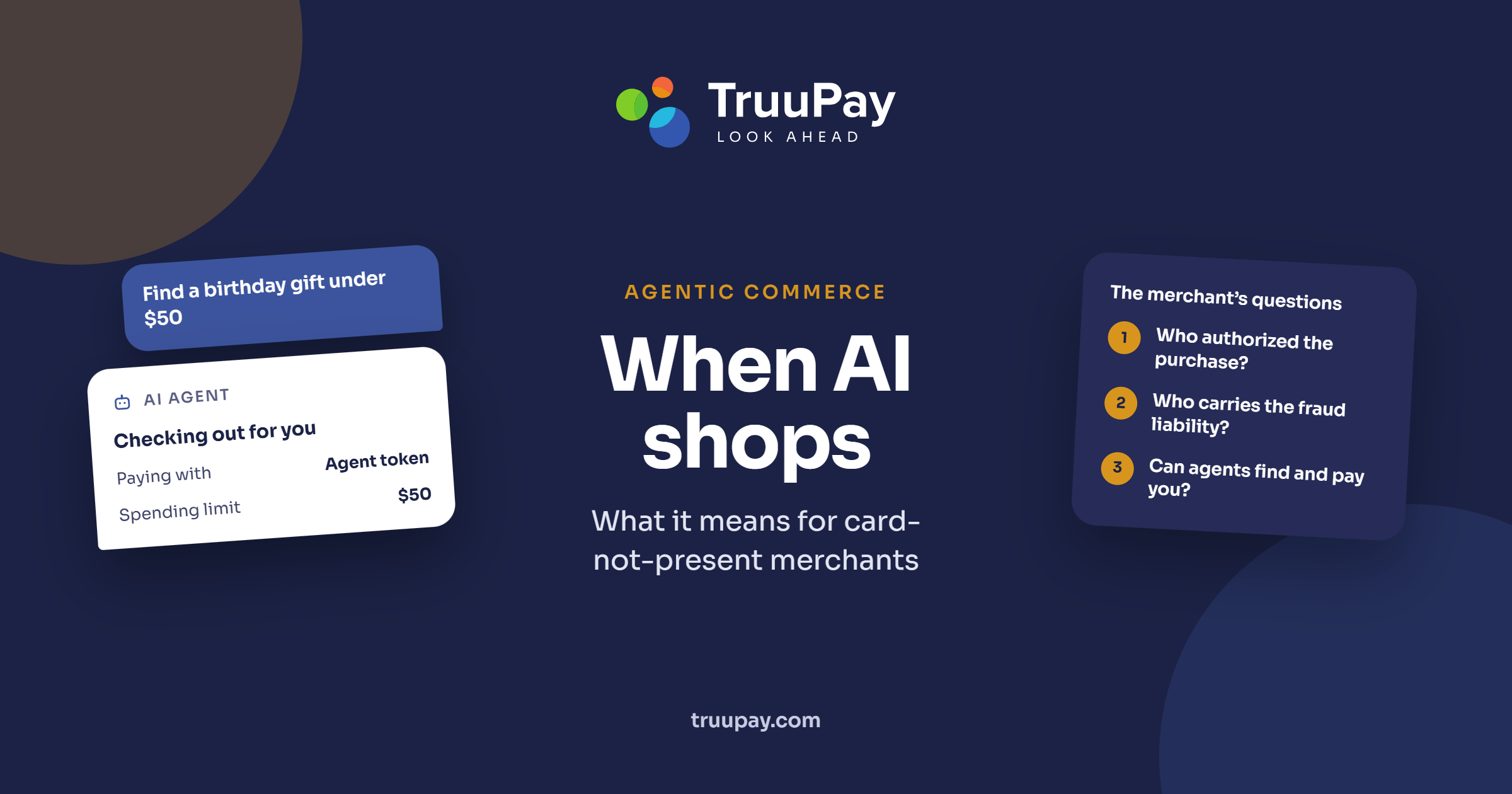
Your next online customer may not be a person. It may be an AI agent that a person told to "reorder the dog food," "find a birthday gift under $50," or "book the cheapest flight on Friday." The agent browses, compares, picks, and pays, and the human may never see your website at all.
This is called agentic commerce, and it is no longer a demo. Visa and Mastercard have both launched programs for it, and live agent-made purchases are already running in several countries. For merchants, it reopens three questions that card-not-present payments had mostly settled: Who authorized this purchase? Who pays if it turns out to be fraud or a mistake? And how does a small business make sure these agents can find it and pay it at all?
Most of the writing on this topic comes from the networks, the AI companies, and the big platforms. This article looks at it from the merchant's side of the counter.
What the card networks are building
Both major networks are adapting tools merchants already know, mainly tokenization, to a buyer that is software.
Mastercard Agent Pay (announced April 2025) issues "agentic tokens" to registered AI agents. Each token stands in for the consumer's card and can carry limits the consumer sets, such as a spending cap or allowed merchants. The consumer can revoke it at any time, and the agent never holds the real card number.
Visa Intelligent Commerce (also April 2025) works the same way on the credential side: tokens scoped to a specific agent and a consumer-set limit. In October 2025 Visa added the Trusted Agent Protocol, built with Cloudflare. It lets a merchant's website check a cryptographic signature and confirm that a visitor is a registered shopping agent, not a scraper or a fraud bot. It can also tell the merchant whether the agent intends to buy or just browse, and whether it is acting for an existing customer.
This is moving fast. In early 2026 Visa reported live agent-completed purchases with issuing banks across Europe, and both networks have run live agent transactions in multiple countries. Visa cited an Adobe figure showing AI-driven traffic to U.S. retail sites up more than 4,700% in a year. That measures visits, not purchases, but the direction is clear.
The simple way to think about it: these programs answer two questions. Is this agent real? and What is it allowed to spend? They do not yet fully answer a third: Who pays when something goes wrong?
Question 1: Who authorized the purchase?
Card rules have always rested on a yes-or-no question: did the cardholder authorize this transaction? With an agent, the honest answer is often "partly."
The consumer authorized the agent. They may have set a budget and a category. But they did not approve the specific item, at the specific price, from your specific store. If the agent buys the wrong size, the wrong brand, or three of something instead of one, the purchase passed every limit check and still isn't what the customer wanted.
The new tokens help with the first layer. A spending cap stops an agent from spending too much. A merchant restriction stops it from shopping in the wrong place. But no token can encode "buy the one I would have picked." That gap between authority granted and purchase intended is where future disputes will come from.
For merchants, this means the proof that matters is changing. It is no longer only "did the card match the billing address?" It is "what did the customer tell the agent to do, and did the agent stay inside those instructions?"
Question 2: Who carries the fraud liability?
In today's card-not-present world, the merchant usually eats fraud losses unless something shifts liability to the issuer, such as a successful 3-D Secure authentication. Agentic commerce does not change that starting point, and so far it has not created a clean new shift.
Here is where things stand as of late 2026:
- Truly unauthorized purchases (a stolen credential, an agent the customer never set up) follow the existing fraud rules. Industry summaries of Mastercard Agent Pay say a validly issued agentic token that stays within its policy is treated like other tokenized transactions, where the issuer carries the fraud risk. Merchants should confirm the details with their processor before counting on it.
- Ordinary merchant disputes (item not received, not as described) work exactly as they do now. The agent doesn't change the outcome.
- "My agent bought the wrong thing" disputes are the gray zone. Neither network has published a specific chargeback rule for a purchase an agent made inside its limits that the customer later regrets. These will likely land as disputes against the merchant.
- The AI platform is generally not on the hook. OpenAI's published spec for agent checkout states that it is not the merchant of record, and that refunds and chargebacks stay with the merchant and its payment provider.
Mastercard's own CEO has publicly flagged "what happens if something goes wrong" as an open question. Until the rules catch up, the safest assumption for a merchant is simple: if you accept agent orders, you own the dispute, so keep the evidence to win it.
Question 3: How do small merchants get found and paid?
Big retailers have teams working on this. A boutique, a specialty shop, or a local service business usually doesn't. That's a risk, because an agent can only buy from a store it can read and check out from.
Three things decide whether an agent can do business with you:
It has to understand what you sell. Agents read structured data, not pretty photos. Clean product titles, prices, sizes, stock levels, shipping costs, and return policies, in a format machines can parse, make you visible. Vague listings make you invisible.
It has to get through your front door. Many small-business sites run bot protection that blocks automated visitors. That's good against scrapers and card-testing attacks, but it can also turn away a legitimate agent with a paying customer behind it. Agent-recognition tools like Visa's Trusted Agent Protocol are designed to solve exactly this, and most merchants will get them through their payment provider or website platform rather than building them.
It has to be able to pay you. Agent payments ride on network tokens. If your payment setup can accept tokenized credentials from your processor, you are most of the way there. If you are on an older setup that only handles raw card numbers, agent checkout will pass you by.
None of this requires a merchant to become an AI expert. It requires a payment partner who is paying attention.
What to do now: a merchant checklist
You don't need to wait for the rules to be final. These steps help today and position you for agent traffic tomorrow.
- Ask your payment provider about tokenization. Confirm you can accept network tokens, and ask what their roadmap is for agent-initiated payments.
- Clean up your product data. Accurate prices, stock, shipping, and return policies help human shoppers and AI agents alike.
- Review your bot rules. Make sure your fraud and bot tools can tell a verified shopping agent from a scraper, instead of blocking all automated traffic.
- Keep better records. Save order details, timestamps, and any agent or token information your system receives. In an agent dispute, the evidence is what the customer authorized, not just that the card cleared.
- Ask the liability question in writing. Ask your provider how they will handle a dispute on an agent-made purchase, and what evidence they will accept.
- Keep your basics strong. Clear descriptors, fast refunds, and good customer service still prevent most chargebacks, whether the buyer is a person or a program.
The merchant's seat at the table
Agentic commerce is being designed right now by card networks, banks, and AI companies. Merchants are the ones who will fulfill the orders, handle the returns, and fight the disputes, yet they have the smallest voice in how the rules get written.
At TruuPay, we think small and mid-sized merchants deserve a payment partner who watches these changes on their behalf and explains them in plain language. The card-not-present future is coming whether a merchant is ready or not. Our job is to make sure you're ready.
Have questions about how agentic commerce could affect your business? Reach out to the TruuPay team at info@truupay.com, call 866-941-3806, or visit truupay.com.
Sources
- Digital Applied: Who Vouches for the Bot? Agent Checkout Authentication (Aug 2026)
- Visa: Visa and Banks Across Europe Reach the Next Phase of Agentic Commerce (Feb 2026)
- Visa Expands Visa Intelligent Commerce Across Asia Pacific (Nov 2025)
- Digital Transactions: Visa Launches Trusted Agent Protocol
- What Is Mastercard Agent Pay?
- Mastercard CEO on agentic commerce liability
Featured Articles

Popular Articles

Dedicated Solutions for Hard-to-Place Merchants
We specialize in bespoke solutions for hard-to-place merchants, offering tailored support and fast approvals. Our team ensures you have the secure, efficient payment processes needed to succeed.

Streamlined Payment Solutions for ISOs & ISVs
As a reseller, you work hard to secure the right providers to reduce your clients’ risks. We make your job easier by accepting all payments under one roof, so that you have more free time to grow your business.
Related Blog Articles
Get the Latest from TruuPay
Sign up for email updates and receive expert insights, industry trends, and exclusive updates!