Mastercard’s New Crypto and Specialty Fees
The Real Cost of Being “High-Risk”
Mastercard just made it more expensive to be a crypto or high-risk merchant, and more expensive to be declined. None of the three new charges looks large on its own. Stacked together, on thin-margin, high-volume businesses, they reshape the economics of card acceptance.
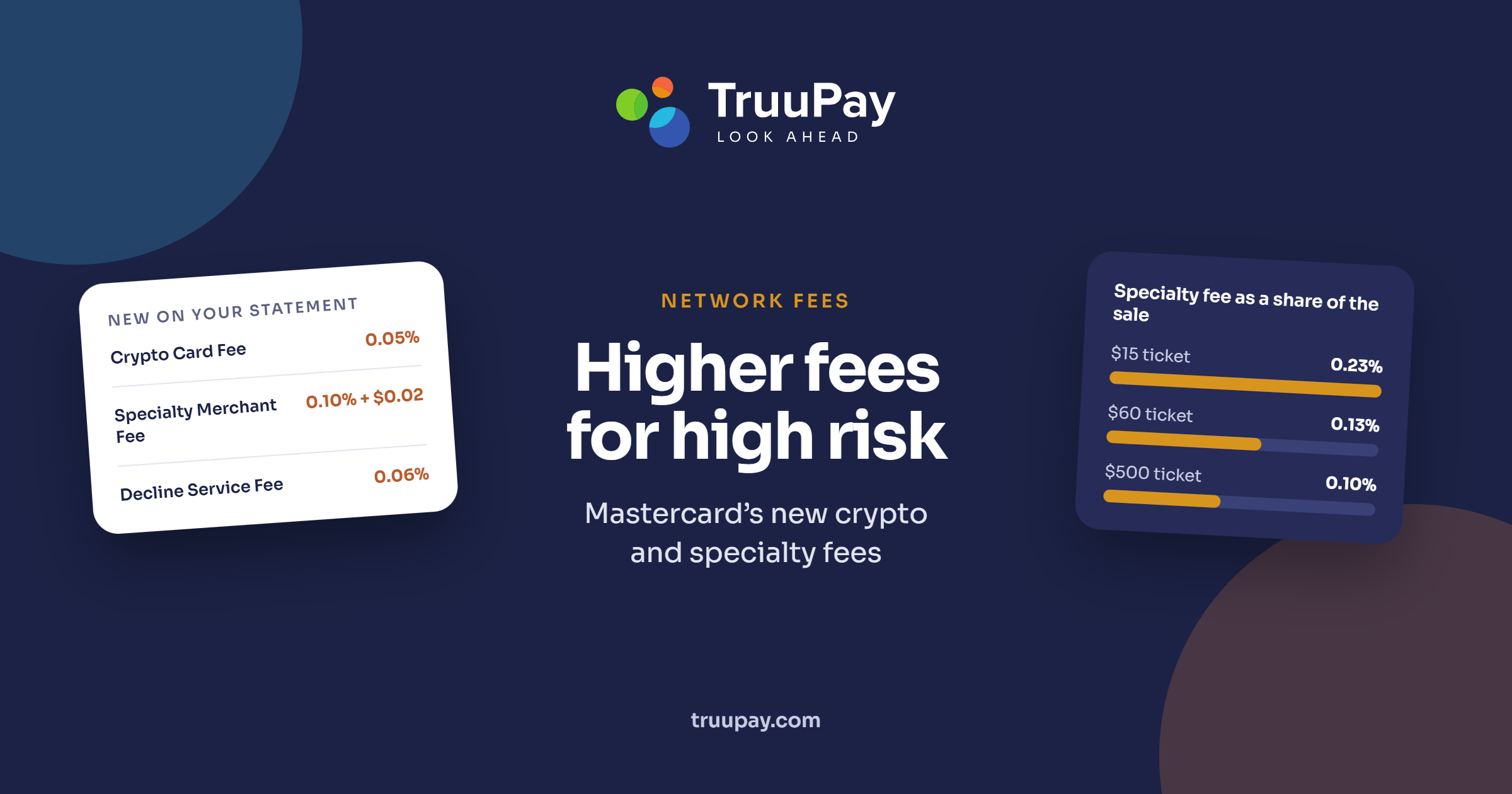
The changes are a 0.05% Crypto Card Fee, a 0.10% + $0.02 Specialty Merchant Fee for merchants registered as high-risk or crypto, and a Decline Service Fee that rises to 0.06% per transaction. Each one is a network fee, so it lands before any processor margin is added.
The headline numbers are small. The message behind them is not: Mastercard is putting a price on risk, and it expects the businesses that create that risk to pay it.
What changed
Three fees now sit on top of interchange and existing assessments for the merchants they touch.
- Crypto Card Fee: 0.05%. A volume-based charge on Mastercard transactions tied to crypto activity. On $1 million a month, that is $500.
- Specialty Merchant Fee: 0.10% + $0.02. Mastercard announced this in its October 28, 2025 bulletin (AN 12568.1) as two new charges: a Specialty Merchant Volume Fee of 10 basis points and a Specialty Merchant Transaction Fee of $0.02 per transaction. The same update raised the annual registration fee to $1,000 per merchant. PayPal Braintree
- Decline Service Fee: raised to 0.06% per transaction. The cost of a declined attempt keeps climbing, which raises the price of sloppy retry logic.
The higher registration fee took effect May 1, 2026. The per-transaction fees followed on June 3, 2026 in the U.S., June 1 in Canada and September 28 in Europe. PayPal Braintree
The Specialty Merchant Registration Program covers more than crypto. It includes online gambling and betting along with other categories Mastercard treats as elevated risk. Merchant Cost Consulting
Mastercard flags specialty transactions with a network-level code, and for most categories it assigns that code based on the merchant. That makes registration status, not just product mix, the thing that decides the bill. Merchant Cost Consulting
Why Mastercard is doing this
The short answer: monitoring high-risk volume costs money, and Mastercard wants that cost tied to the merchants who generate it. Flat annual registration fees did not scale with volume. A percentage plus a per-item charge does.
The pricing came with tighter control. Since May 1, 2026, acquirers need Mastercard’s express written consent before boarding a specialty merchant, and unregistered specialty merchants can trigger assessments of up to $10,000. Merchant Cost Consulting
The decline fee follows the same logic. Every failed authorization consumes network and issuer capacity, and card testing runs on declines. Raising the price of a decline pushes merchants to clean up retries and fraud screening.
The crypto fee lands in an odd moment. Mastercard is investing heavily in crypto and stablecoin infrastructure while charging crypto merchants more to accept its cards. Read together, the signal is clear: crypto is welcome on Mastercard’s rails, on Mastercard’s risk terms.
Who feels it, and what it costs
Small-ticket specialty merchants feel it most, because the $0.02 per-item charge weighs heavier on a small sale. Here is how the Specialty Merchant Fee works out at three average tickets:
- $15 ticket: $0.015 + $0.02 = $0.035, or about 0.23% of the sale.
- $60 ticket: $0.06 + $0.02 = $0.08, or about 0.13%.
- $500 ticket: $0.50 + $0.02 = $0.52, or about 0.10%.
Now take a specialty merchant running 800 Mastercard sales a month at $60, or $48,000 in volume. The volume fee is $48 and the transaction fee is $16, so $64 a month and $768 a year. Add the $1,000 annual registration fee per merchant account and the visible cost reaches $1,768 a year. Merchant Cost Consulting
Refunds make it worse. Industry analysts report the fee applies to both the original sale and the refunded amount, so a returned $100 order is charged twice. Merchant Cost Consulting
The Crypto Card Fee scales with volume: 0.05% is $500 on every $1 million of qualifying Mastercard sales. The Decline Service Fee at 0.06% is small per attempt, but it compounds during card-testing attacks and aggressive retry cycles, exactly when a merchant is least prepared.
What merchants, ISVs and agents should do now
The merchants who come out ahead will treat these fees as a design problem, not a line item.
- Read your statement for the new codes. Look for specialty volume and transaction fees, crypto fees and decline charges. If you cannot find them, ask your provider how they are being billed.
- Confirm your registration status. Specialty registration follows what you actually sell, not just your MCC. Being registered when you should not be costs money; being unregistered when you should be risks your account.
- Check how your transactions are flagged. Mastercard usually assigns the specialty flag by merchant. If only part of your business belongs in the program, ask whether that activity can be boarded separately.
- Fix your retry logic. Honor Mastercard merchant advice codes, stop retrying hard declines, and space out soft-decline retries.
- Shut down card testing. Velocity limits, bot screening and 3-D Secure on risky traffic cut the declines that now carry a higher price.
- Revisit small-ticket pricing. Where the $0.02 item fee is a large share of margin, minimum purchase amounts or bundling can protect it.
- ISVs and agents: get ahead of the conversation. Explain the change to your merchants before their statement does. Trust is easier to keep than to rebuild.
The bigger picture: transparency is the product
Network fees will keep rising. What merchants can control is whether those fees arrive as a surprise or as a known, explained cost.
That is the real test of a payments partner. Do they pass network fees through at cost, label them clearly, and tell you before they change? Or do they fold them into a vague “processing” line with a markup on top?
At TruuPay, we believe merchants deserve to see exactly what the networks charge and why. If you run a crypto, high-risk or small-ticket business and want a clear read on what these changes mean for your statement, reach out at info@truupay.com or 866-941-3806.
Sources
- Mastercard, AN 12568.1: New and Updated Specialty Merchant Registration Program Fees, October 28, 2025
- Card Network Updates: Fall 2026 Release+ Guide, PayPal Braintree, September 4, 2026
- Mastercard Specialty Merchant Registration Program & Fees, Merchant Cost Consulting
Featured Articles

Popular Articles

Dedicated Solutions for Hard-to-Place Merchants
We specialize in bespoke solutions for hard-to-place merchants, offering tailored support and fast approvals. Our team ensures you have the secure, efficient payment processes needed to succeed.

Streamlined Payment Solutions for ISOs & ISVs
As a reseller, you work hard to secure the right providers to reduce your clients’ risks. We make your job easier by accepting all payments under one roof, so that you have more free time to grow your business.
Related Blog Articles
Get the Latest from TruuPay
Sign up for email updates and receive expert insights, industry trends, and exclusive updates!