The Payments Gap: Why Franchise Tech Stacks Break at the Operations Layer
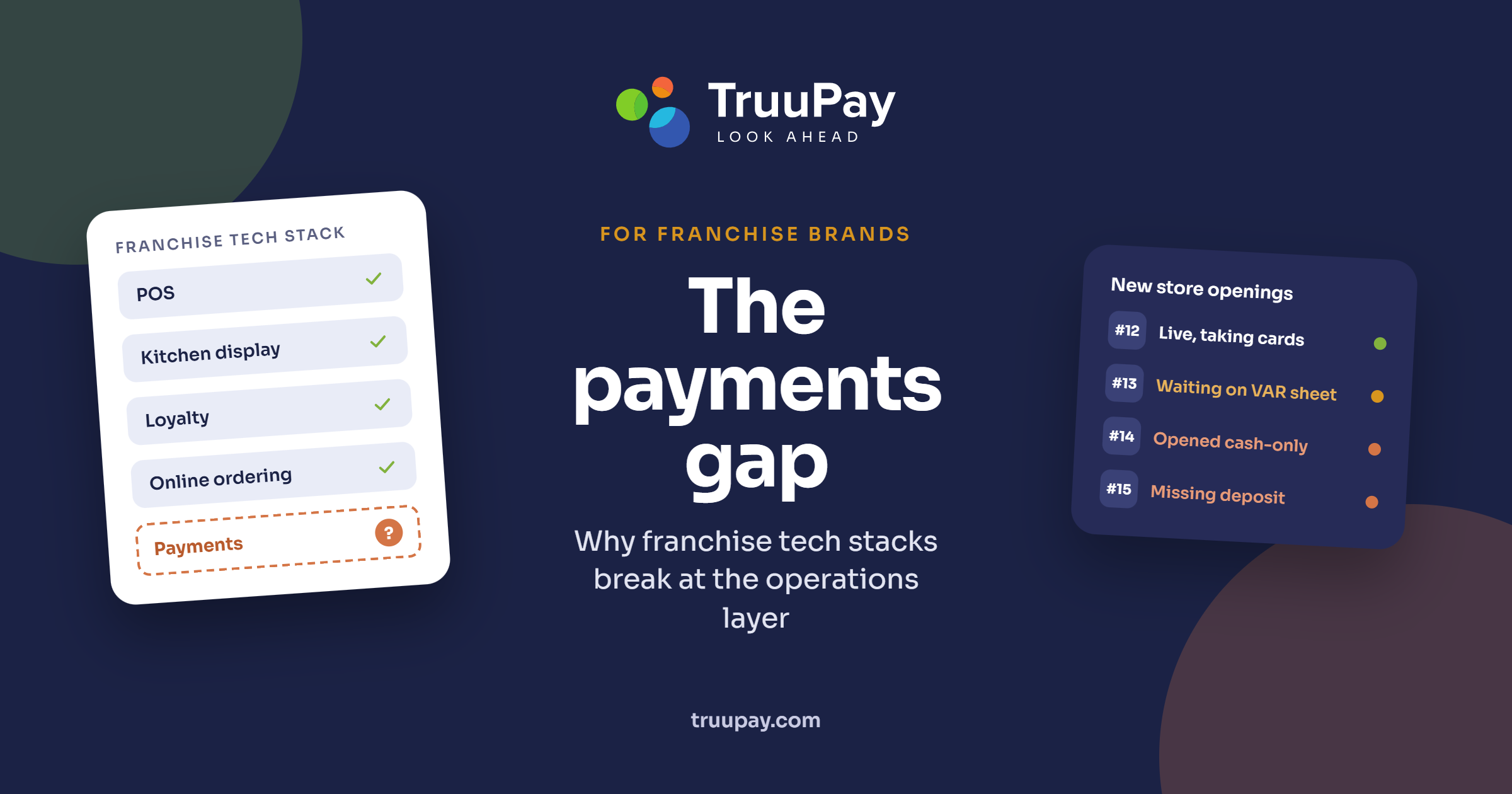
Why Franchise Tech Stacks Break at the Operations Layer
Most franchise systems don't have a payments problem. They have a payments operations problem, and it hides in the space between the POS they chose and the processor their franchisees actually sign with.
Franchise CTOs spend months evaluating POS platforms, kitchen display systems, loyalty engines and online ordering. Those decisions get architecture reviews, pilots and rollout plans. Payments usually gets a rate sheet and a referral.
The gap is also a brand gap. Franchisors standardize menus, POS, signage and suppliers, yet in most systems each franchisee signs its own processing agreement. The IFA projects about 845,000 US franchise establishments in 2026 (IFA 2026 Franchising Economic Outlook), and for most of them, how customers pay is the one brand touchpoint corporate doesn't control.
Recommending or mandating a processor rarely closes that gap. Franchisees still chase applications, negotiate pricing and call for support on their own, and corporate still can't see what's happening.
Then the system scales. Fifty new units open with fifty slightly different merchant setups. A terminal ships with the wrong encryption key and a store opens cash-only. A franchisee calls corporate IT about a missing deposit, and nobody at corporate can see the account. The tech stack works on paper, but payments, the one system that touches every transaction, runs outside of it.
Payments orchestration for a franchise is not a pricing exercise. It is a coordination problem across six stages: choosing a partner, onboarding merchants, deploying hardware and software, supporting locations, reconciling statements, and seeing the data. Each stage has its own owners, failure points and lead times. This article walks through each one and what a CTO should demand from it.
1. Choosing a payments partner: evaluate the operation, not the rate
The right payments partner is the one that fits your operating model, and rate is the easiest thing to fix later. A partner that saves 10 basis points but can't support your POS, your boarding volume or your reporting needs will cost far more in IT hours and franchisee frustration.
CTOs should pressure-test four areas before signing anything:
- POS and software integration. Is the gateway certified on your POS, KDS and online ordering stack today? Which device models are supported, and who owns recertification when your POS vendor ships a major release? If your mandated POS bundles its own payments, be careful. Bundled models often offset cheap hardware with higher processing margins, and that hardware usually works only with their processor. The upfront savings fade over years of fees, and switching later means replacing devices at every store. A payments-agnostic POS keeps processing a separate decision you can revisit as the system grows.
- Multi-location structure. Can the partner build a hierarchy of franchisor, franchisee entity and location, with one merchant account (MID) per store rolling up to a single view?
- Franchisor-level controls. Can corporate set standard pricing, configurations and device profiles, while franchisees keep ownership of their own merchant accounts?
- Program ownership. Some partners can let the franchisor run payments as its own branded program, with a branded portal and statements, while the partner handles underwriting, processing and back-end support.
A useful test cuts through all four: will this partner simply become a recommended vendor, or will it let corporate run payments as part of its own operating model? A recommended vendor still leaves every franchisee to onboard, negotiate and get support alone.
Ask for references from other multi-unit brands, and ask those references about the first 90 days after a store opens, not the sales process.
2. Application and onboarding: where store openings slip
Onboarding is the stage most likely to delay a grand opening, because every franchisee is a separate legal entity that must be underwritten on its own. Your brand may be uniform, but your merchants are not.
One operator applies as an LLC with a decade of processing history. Another is a first-time owner with a new EIN and no statements. A third owns 12 units across three entities. Each needs its own application, KYC documents, beneficial ownership details, bank verification and underwriting review. Missing a voided check or a mismatched business name can stall approval for days.
The operational fixes are straightforward, but they have to be designed in:
- Standardize the application. Pre-fill brand-level data such as MCC, average ticket, business description and equipment so franchisees only supply what's unique to them.
- Tie boarding to the opening calendar. Applications should start 45 to 60 days before opening, triggered by the development team's timeline, not by the franchisee remembering to call.
- Use a document checklist. One list of required items, collected once, reviewed before submission.
- Plan for multi-unit operators. Adding a location for an existing approved owner should be a short add-on, not a full new application.
- Track status centrally. Corporate should see every pending application, what it's waiting on and its expected approval date.
Two decisions belong in the onboarding design from the start. First, existing locations rarely switch at once, because most are under processing contracts; make new openings the default path and migrate other stores as their agreements end. Second, decide who owns the onboarding step. When each franchisee applies to a processor directly, corporate has no role in collecting documents and no standing access to the data, so it has to request both after the fact. When the franchisor runs the program itself, as the reseller its franchisees board through, it collects the documents, tracks every application, and has data access written into the program terms franchisees accept at signup. Visibility becomes part of the structure, not a favor requested store by store.
When onboarding lives in email threads between a franchisee and a sales rep, corporate learns about a problem when the store can't take cards.
3. Hardware and software deployment: the handoff no one owns
Deployment is where your POS decision and your payments decision finally meet, and it is the stage with the most handoffs. An approved merchant account is useless until the right device, loaded with the right credentials, is talking to the right POS at the right store.
A single location's go-live typically touches the processor, the gateway, the POS vendor, the hardware supplier, a deployment or VAR team, corporate IT and the franchisee. Common failure points include:
- Configuration data. Terminal IDs, merchant IDs and gateway credentials must be built into a VAR or parameter sheet and applied correctly in the POS. One wrong digit means declined transactions on day one. Just waiting for a processor to issue the sheet often holds a new store up for weeks.
- Device provisioning. Payment devices need encryption keys injected and must be certified for your specific POS and gateway combination.
- Logistics. Devices ship to the right address, arrive before the install date and are tracked like any other critical asset.
- Testing. Live test transactions, refunds, tips and offline mode should be verified before opening day, not during the first lunch rush.
- Version control. When the POS vendor updates software or a device reaches end of life, someone has to plan the migration across hundreds of locations.
The fix is a standard deployment playbook: a brand-approved device profile, a templated VAR sheet, a pre-opening test script, a named owner for every step, and an opening tracker that follows each new location from application to first transaction. With those in place, payments setup can take days instead of weeks. Corporate IT should be able to answer, for any store, which devices are installed, what software they run and when they were last updated.
4. Support and statements: the long tail after go-live
Once a store is live, payments becomes a support function, and the question every franchisee asks is simple: who do I call? If the answer is unclear, they call corporate IT, their POS vendor and their processor in turn, and each one points to the other.
A clear support model assigns issues by type:
- Device offline or card reader errors. The franchisor or POS help desk takes the first call and escalates to processor or hardware support.
- Missing or short deposits. The payments partner owns these, working with the processor and sponsor bank.
- Chargebacks and disputes. The franchisee responds with guidance from the payments partner, backed by the processor's risk team.
- Pricing or statement questions. The payments partner answers first, with the franchisor's program owner as the escalation point.
- POS menu or tip settings. The POS vendor handles these and escalates to the gateway or deployment team.
The most effective franchise programs give the franchisor a level 1 support role, backed by the payments partner and processor. Franchisees get one familiar first call, and corporate gets visibility into recurring issues across the system.
That model only works if level 1 is set up deliberately. The franchisor's team needs training, documentation and scripts, plus agreed escalation paths and service levels with the payments partner. Smaller systems without that capacity can have the partner run level 1 under the brand's name until the team is ready.
Statements deserve the same attention. When each franchisee receives a different statement format, pricing model or fee schedule, corporate can't compare locations or answer basic questions. A consistent statement and pricing structure across the system makes it easier to explain costs, spot errors and catch unexpected fees early.
Transparency matters as much as format. If corporate shapes what franchisees pay, every part of that price, including any franchisor margin, should be disclosed up front, and revenue from franchisee purchases may need disclosure in FDD Item 8 (Franchise Law Solutions). Trust breaks fastest when franchisees find a fee on their own.
5. Reporting and visibility: one view of every location
Payments data is the most accurate record of what happens at every store, yet most franchisors can't see it. Sales data flows into the POS and up to corporate. Payments data, including fees, deposits, chargebacks and declines, stays locked inside individual merchant portals.
A mature program gives corporate a consolidated, system-wide view while keeping each franchisee's access limited to their own locations. That view should cover:
- Funding reconciliation. Match POS sales to processed volume to deposits, by location and by day, so missing or late funding surfaces in hours rather than at month-end close. The same match lets finance compare card sales with franchisee-reported sales for royalty review.
- Cost benchmarking. Compare effective rates, card mix and fees across stores to find outliers and pricing errors.
- Exception monitoring. Flag unusual decline rates, chargeback spikes, refund patterns or devices that stop transacting.
- Operational trends. Track average ticket, tip rates and card-present versus online mix as inputs to menu, staffing and marketing decisions.
Three design choices decide whether anyone trusts that view:
- Hierarchy. Map every MID to franchisor, region, owner group and location, so multi-unit owners roll up correctly.
- Access and consent. Executives see the system, field consultants see their territory, and franchisees see only their own units, all backed by consent captured at boarding.
- Honest labeling. Payments data covers card sales, not cash or third-party delivery. Label it clearly so no one mistakes it for total sales.
For CTOs, the key requirement is that this data is accessible, through a portal for operators and through APIs or exports for your data warehouse. Payments data that can't be joined to POS and labor data is only half useful.
6. A practical playbook for franchise CTOs
Treat payments as part of your technology stack, with the same ownership, standards and reviews as your POS. Before your next partner review or new-unit rollout, make sure you can answer each of these:
- Partner selection (CTO and finance). Will our partner let us run payments as part of our operating model, or just be a recommended vendor?
- Onboarding (development and payments partner). Does boarding start automatically from the opening calendar, with a standard application and data access built into the program terms?
- Deployment (corporate IT and deployment team). Do we have a brand device profile, templated VAR sheet, pre-opening test script and opening tracker?
- Support (franchisor support and payments partner). Does every franchisee know who to call first, and is our level 1 team trained with clear escalation paths?
- Statements (finance, legal and payments partner). Are pricing and statements consistent across locations, with any franchisor margin disclosed?
- Reporting (CTO and data team). Can we reconcile sales, volume and deposits for every store, with role-based access and a feed into our data warehouse?
If more than two answers are "no" or "we'd have to ask," payments is running outside your stack. That gap shows up as delayed openings, avoidable support calls and fees nobody can explain.
Closing the gap
Franchisors already treat menus, POS and suppliers as brand standards, because consistency is what makes a system work. Payments touches every transaction in every one of those stores and deserves the same treatment: designed, owned and measured from the opening calendar to the monthly close.
Payments orchestration done well is mostly invisible. Stores open on schedule, devices work on day one, franchisees know who to call, and corporate can see the whole system in one place. Getting there takes deliberate design across every stage, not a better rate.
Barry L. Prentice is with TruuPay, a payments company that helps franchisors and software providers run payments as part of their own operations. He previously worked at a large POS company serving mid-to-large franchise brands. Learn more at truupay.com.
Featured Articles


Popular Articles

Dedicated Solutions for Hard-to-Place Merchants
We specialize in bespoke solutions for hard-to-place merchants, offering tailored support and fast approvals. Our team ensures you have the secure, efficient payment processes needed to succeed.

Streamlined Payment Solutions for ISOs & ISVs
As a reseller, you work hard to secure the right providers to reduce your clients’ risks. We make your job easier by accepting all payments under one roof, so that you have more free time to grow your business.
Related Blog Articles
Get the Latest from TruuPay
Sign up for email updates and receive expert insights, industry trends, and exclusive updates!