Why Fast Scaling Kills E-Commerce Accounts (And How to Protect Your Cash Flow)
The Phone Call Every Owner Dreads
Imagine this scenario: After months of testing ad copy, optimizing your landing pages, and dialing in product-market fit, your new promotional offer takes off.
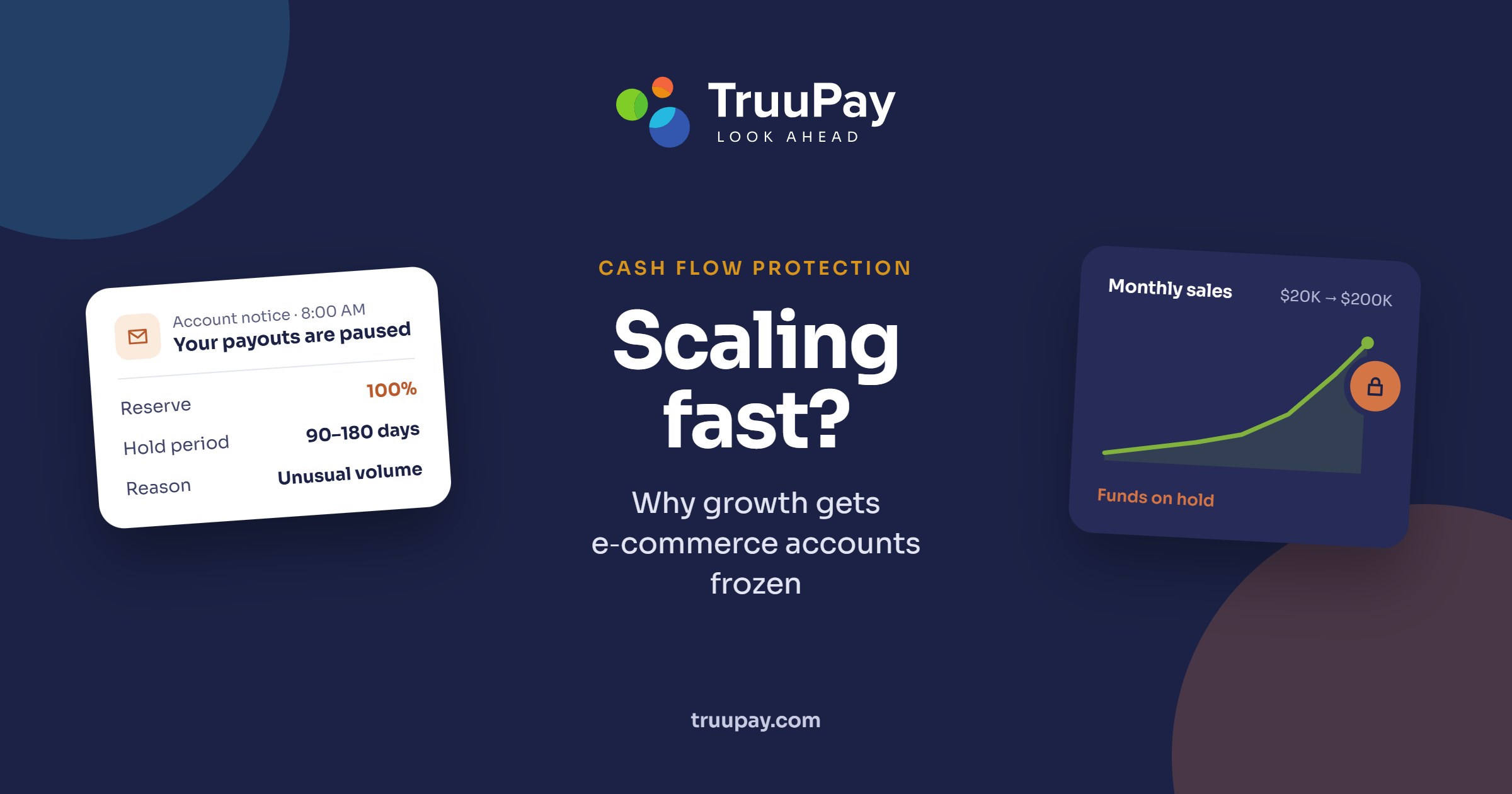
Your daily ad spend scales from $500 to $5,000. Sales explode. You went from doing $20,000 a month to pacing for $200,000. You contact your supplier to double your inventory order, send bonuses to your support team, and start planning your next product drop.
Then, at 8:00 AM on a Tuesday, an email hits your inbox:
"During a routine review of your account, we noticed an unusual increase in transaction volume. To protect against potential losses, your payouts have been paused and a temporary reserve of 100% has been placed on your account for 90 to 180 days."
In an instant, your revenue is locked away. Your credit cards are maxed out from ad spend, your supplier is waiting for payment, and your merchant dashboard offers no phone number to call, just a generic support ticket system with an automated response time of 3 to 5 business days.
This isn't a rare anomaly. It happens every single day to thousands of scaling e-commerce brands, coaching programs, and subscription services.
The businesses that recover fastest from this aren't the ones with the best product or the biggest ad budget. They're the ones whose payment infrastructure was built to expect growth, not just react to it after the fact. To get there, you need to understand why payment processors treat your success as a threat, and how to build infrastructure that supports growth instead of capping it.
The Aggregator Trap: Why Stripe, PayPal, and Shopify Freeze Accounts
To understand why your funds get frozen, you have to look at how modern payment processing works under the hood.
Most businesses start out using payment aggregators (also known as Payment Facilitators or PayFacs) like Stripe, PayPal, Square, or Shopify Payments.
1. Instant Onboarding Means "Underwrite Later"
Aggregators allow you to start taking payments in under five minutes without speaking to a human. How do they afford to take on that risk? By skipping the underwriting process upfront.
Instead of evaluating your supply chain, bank statements, or fulfillment times before you process your first dollar, aggregators let everyone in through the front door. They use automated risk algorithms to monitor your account after you start taking transactions.
2. The Shared Account Model
When you process payments through an aggregator, you don't actually have your own merchant account. You are sharing one giant sub-account with hundreds of thousands of other businesses.
If a sudden spike in volume occurs on your account, the aggregator's risk engine flags it as potential fraud or high-risk activity (a hacked account, stolen card testing, or a sign that you won't be able to fulfill orders). Because you share an account with thousands of other merchants, the aggregator will always prioritize protecting their overall business over preserving your individual cash flow. They freeze first and ask questions later.
3. Algorithmic Risk Triggers
Based on what our underwriting team sees across the accounts we work with, the most common triggers for holds on aggregator platforms include:
- Rapid Volume Spikes: Increasing processing volume by more than 200–300% month-over-month.
- Higher Ticket Sizes: A sudden influx of transactions significantly higher than your historic average order value (AOV).
- Fulfillment Delays: Pre-orders or long delivery times where the gap between charge date and delivery date exceeds 7–10 days.
- Minor Chargeback Blips: Crossing a 0.5% or 1% chargeback ratio during a volume scale-up.
These aren't official published thresholds, since aggregators don't disclose their exact risk models. But they reflect patterns our team has consistently seen trigger holds across hundreds of scaling merchant accounts.
How to Build Bulletproof Payment Infrastructure
Scaling a business on an aggregator account is like building a skyscraper on a sand foundation. It works fine for a two-story house, but it collapses under real weight.
When your business consistently generates $30,000 to $50,000+ per month, it's time to consider upgrading to a Dedicated Merchant Account (MID) architecture.
Step 1: Upfront Human Underwriting
With a dedicated merchant account, the underwriting process happens before you process your first high-volume month. A human underwriter reviews your processing history, chargeback ratios, refund policies, and supplier lead times. Once approved, the processing bank expects your high volume, meaning a $100k day won't trigger an automated panic freeze.
Step 2: Build in Redundancy Across Banking Partners
The biggest vulnerability in modern payment processing is relying on a single bank pipeline. If an acquiring bank shifts its internal risk policies overnight or experiences a technical bottleneck, a single-bank processor has no choice but to pause your account or hold your funds.
The fix is redundancy: having more than one bank capable of processing your volume, so a policy change at one institution can't take your storefront offline. This is the principle behind how we built TruuPay. Instead of locking merchants into one rigid banking pipeline, we underwrite and position businesses across multiple vetted banking partners.
In practice, that looks like:
- MID Redundancy: If one bank updates its risk parameters or flags a sudden sales surge, processing can shift to a secondary partner without re-underwriting the business from scratch.
- Risk Matching: Different banks have different appetites for specific verticals, high-ticket items, or subscription models. Businesses get paired with the partner best suited to their volume and industry.
- Continuity: Because the banking rails are diversified behind the scenes under one account, the storefront stays live and ad spend stays active even if one banking relationship runs into friction.
The goal is the stability of an enterprise, multi-bank setup, without the merchant having to manage multiple relationships themselves.
Step 3: Proactively Manage Chargebacks and Fraud
Chargebacks and payment fraud are among the most common reasons banks place holds on fast-scaling merchant accounts. Crossing standard dispute thresholds doesn't just result in unexpected fees. It signals to risk departments that a business model is unstable.
Rather than leaving merchants to manually manage disputes or patch together third-party apps, this needs to be built into the payment relationship itself:
- Early-warning alerts that catch customer complaints at the bank level before they escalate into formal chargebacks, so issues get resolved before they hit a merchant's dispute ratio.
- Fraud filtering that catches fraudulent transactions and card-testing attempts before they hit checkout, preventing sudden spikes in disputed volume.
- Streamlined dispute resolution, so when invalid claims do occur, the evidence process doesn't pull a founder's attention away from running the business.
Step 4: Ask for Real Human Advocacy
Before signing with any payment provider, test their support team. Ask them directly:
- Do I get a direct account manager, or a ticket queue?
- If a bank places a reserve on my funds, who negotiates with the risk department on my behalf?
- Will you help me set up backup processing routing as I scale?
If the answers are vague, that's the signal.
Growth Requires a Partner, Not Just a Software App
Your payment processor shouldn't be a spectator watching your growth with suspicion. It should be infrastructure built for the volume you're heading toward, not just the volume you have today.
At TruuPay, we work with scaling brands, subscription models, and high-volume e-commerce stores on dedicated merchant accounts, multi-bank redundancy, and proactive bank advocacy, so the backend mechanics aren't something founders have to think about while they're focused on media buying, product development, and scaling safely.
If you're currently processing through an aggregator and doing $30K+/month, it's worth a 15-minute gut-check on whether your current setup could hold up under a real scale event, before you find out the hard way. Happy to do that for free. Drop a comment or send a DM if you'd like a second set of eyes on your setup.
Featured Articles

Popular Articles

Dedicated Solutions for Hard-to-Place Merchants
We specialize in bespoke solutions for hard-to-place merchants, offering tailored support and fast approvals. Our team ensures you have the secure, efficient payment processes needed to succeed.

Streamlined Payment Solutions for ISOs & ISVs
As a reseller, you work hard to secure the right providers to reduce your clients’ risks. We make your job easier by accepting all payments under one roof, so that you have more free time to grow your business.
Related Blog Articles
Get the Latest from TruuPay
Sign up for email updates and receive expert insights, industry trends, and exclusive updates!