


What's Really Behind a Card Swipe
Gateway, processor, merchant account, POS: learn what each piece of your payment setup does, how they fit together, and why it matters to your business.

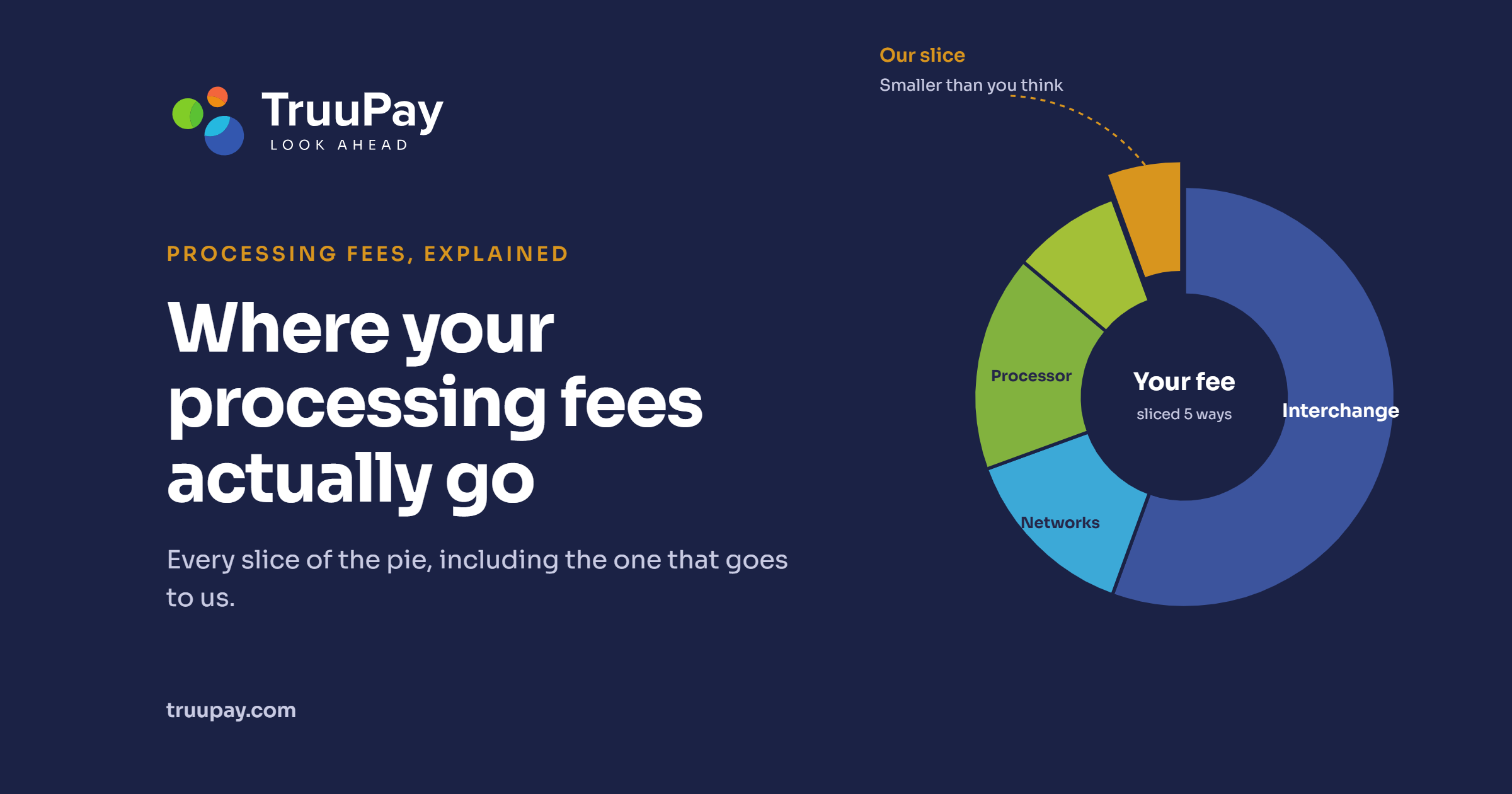
Most business owners open their monthly processing statement, glance at the total, wince, and close it. That’s understandable. Statements are dense, the line items are cryptic, and it can feel like the whole system was designed to be confusing.
So let’s do something our industry doesn’t do often enough: walk through where your processing fees actually go, layer by layer. Including the part that goes to us.
Every time a customer taps, dips, or swipes a card, a lot happens in about two seconds. The transaction is routed across networks, checked for fraud, approved by the customer’s bank, and later settled into your account. The money moves from one institution to another, and every institution along the way takes on cost and risk to make that happen.
Your processing fee pays for a few core things:
Think of your processing fee as a pie that gets sliced several ways before anyone in the middle sees a dollar. The biggest slices are set by the card networks and banks, and they’re the same no matter who you process with.
Who: Your customer’s bank (the card issuer).
What it covers: Fraud risk, cardholder rewards, and the cost of extending credit. This is usually the largest share of your total cost.
Can your provider change it? No. Rates are published by Visa, Mastercard, and others.
Who: Visa, Mastercard, Discover, and Amex.
What it covers: Running the networks that connect banks worldwide. A small percentage plus per-item fees.
Can your provider change it? No. It’s the same for every merchant.
Who: The companies that move transactions and hold your merchant account.
What it covers: Authorization, settlement, funding your account, and taking on the risk of your business.
Can your provider change it? Partly, through negotiated pricing.
Who: Software and hardware providers.
What it covers: Securely connecting your POS, terminal, or website to the processor.
Can your provider change it? Yes, depending on your setup.
Who: The people you actually talk to.
What it covers: Onboarding, pricing guidance, support, and advocacy when something goes wrong.
Can your provider change it? Yes. This is our margin.
The first two layers, interchange and network fees, are often called “pass-through” costs. They pass straight through your provider to the banks and networks. No honest provider can make them disappear.
We’d rather say this plainly than have you wonder: TruuPay earns a share of your processing fees. That’s how we keep the lights on, pay our team, and stay around to support you.
But it’s a smaller piece than most people assume. By the time interchange goes to the card-issuing bank, the networks take their assessments, and the processor covers settlement and risk, what’s left for a provider like us is a modest slice of the whole.
Why say this out loud? Because when a salesperson promises to “slash your fees in half,” you deserve to know which part of the pie they can actually touch. Real savings usually come from fair markup, the right pricing model for your business, and avoiding unnecessary add-on fees. Not from magic.
If the biggest costs are fixed, what’s the difference between one provider and another? Mostly, it’s the relationship.
It’s whether someone picks up when your terminal fails on a Saturday. It’s whether your rates quietly creep up after year one, or someone reviews your statement with you and tells you the truth. It’s having a person on your side when a chargeback lands or your funding is delayed.
That’s what our piece of the pie pays for. We can’t change what Visa charges. We can make sure you understand every line on your statement, get pricing that fits your business, and never feel like you’re on your own. In an industry built on fine print, we think that’s worth something.

We specialize in bespoke solutions for hard-to-place merchants, offering tailored support and fast approvals. Our team ensures you have the secure, efficient payment processes needed to succeed.

As a reseller, you work hard to secure the right providers to reduce your clients’ risks. We make your job easier by accepting all payments under one roof, so that you have more free time to grow your business.
Sign up for email updates and receive expert insights, industry trends, and exclusive updates!